

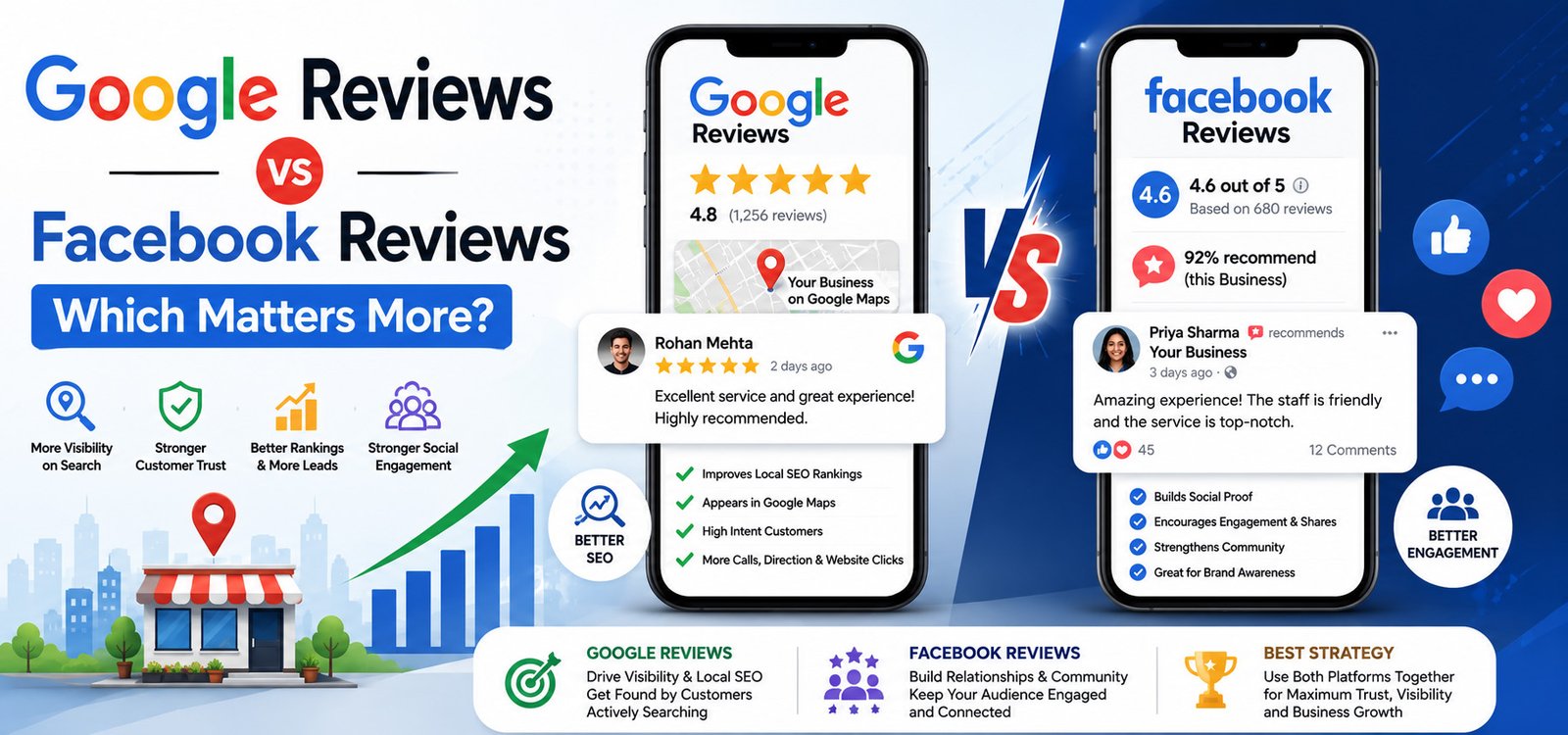
In today's digital-first world, online reviews have become one of the most influential factors in how customers choose local businesses. Before visiting a restaurant, booking a hotel, selecting a dentist, or hiring a contractor, most people read reviews to determine whether a business is trustworthy and worth their time.
Among the many review platforms available, Google Reviews and Facebook Reviews remain two of the most widely used. Both allow customers to share their experiences, rate businesses, and influence purchasing decisions. However, they serve different purposes and have different impacts on visibility, customer trust, and business growth.
Many business owners ask the same question:
Which platform matters more—Google Reviews or Facebook Reviews?
The answer depends on your goals. If your objective is to improve Local SEO and appear higher in Google Search and Google Maps, Google Reviews have a clear advantage. If your goal is to build an engaged community and encourage social sharing, Facebook Reviews still provide value.
In this article, we'll compare both platforms in detail, explain how they influence customer decisions, and help you determine where to focus your review strategy in 2026.
Understanding Google Reviews
Google Reviews are customer ratings and feedback left on your Google Business Profile. Whenever someone searches for your business or a service in your area, these reviews appear directly in Google Search and Google Maps.
A Google review includes:
- Star rating
- Written feedback
- Customer photos (optional)
- Review date
- Business owner's response
Because Google Reviews are integrated directly into Google's search ecosystem, they play a significant role in how businesses appear in local search results.
For example, when someone searches for "best coffee shop near me", Google often displays businesses with strong ratings, consistent reviews, and active customer engagement.
Understanding Facebook Reviews
Facebook Reviews are recommendations and ratings customers leave on your Facebook Business Page. These reviews help visitors understand how other customers feel about your business before they contact you or send a message.
Unlike Google Reviews, Facebook Reviews are closely tied to social engagement. Customers can:
- Recommend a business
- Write detailed experiences
- Upload photos and videos
- Share reviews with friends
- Interact through comments and reactions
Facebook Reviews are particularly valuable for businesses that actively market on social media and maintain an engaged audience.
Google Reviews vs Facebook Reviews
Search Visibility
One of the biggest differences between the two platforms is visibility.
Google Reviews appear directly in:
- Google Search
- Google Maps
- Local Pack results
- Mobile searches
- Voice searches
Whenever users search for nearby businesses, Google Reviews become part of the search experience.
Facebook Reviews, however, are generally visible only when users visit your Facebook Business Page.
This means Google Reviews reach customers earlier in their buying journey.
Winner: Google Reviews
Impact on Local SEO
Google Reviews are one of the strongest Local SEO signals.
Google considers:
- Review quantity
- Average rating
- Review freshness
- Keywords inside reviews
- Customer engagement
- Owner responses
These factors help determine whether your business appears in Google Maps and local search results.
Facebook Reviews do not directly influence Google's ranking algorithm.
Although Facebook pages may appear in search results, Facebook Reviews themselves do not significantly improve Google Maps rankings.
Winner: Google Reviews
Customer Trust
Trust is essential when customers compare multiple businesses.
Google Reviews often appear before customers even visit your website.
Seeing hundreds of authentic reviews with high ratings immediately builds confidence.
Facebook Reviews also establish trust, especially when customers can see:
- Mutual friends
- Shared experiences
- Community engagement
- Photos and comments
For socially active audiences, Facebook can feel more personal.
Overall, Google remains the platform customers check first.
Winner: Google Reviews
Review Accessibility
Leaving a Google Review has become extremely simple.
Customers can:
- Scan a QR code
- Click a review link
- Search your business
- Leave a review without following your page
Facebook Reviews generally require customers to visit your business page and, in many cases, log into Facebook.
Many younger users today spend more time on Instagram, TikTok, or Google Search than Facebook.
Because Google Reviews require fewer steps, businesses usually receive more reviews.
Winner: Google Reviews
Audience Reach
Google serves billions of searches every day.
Almost everyone uses Google to find nearby businesses.
Facebook remains one of the largest social media platforms, but many users visit it for entertainment rather than business discovery.
Google captures customers who already have buying intent.
Facebook often captures customers during casual browsing.
Businesses generally receive higher-quality leads from Google.
Winner: Google Reviews
Buying Intent
Customer intent differs significantly.
Someone searching:
"Best dentist near me"
already intends to book an appointment.
Someone scrolling Facebook may not currently need dental services.
Because Google users actively search for solutions, Google Reviews influence purchasing decisions at the perfect moment.
This dramatically increases conversion rates.
Winner: Google Reviews
Social Sharing
Facebook shines when it comes to community engagement.
Customers can:
- Share recommendations
- Tag friends
- Comment on reviews
- Start discussions
- Share photos
These social interactions increase brand awareness organically.
Google Reviews offer very limited social interaction.
Businesses focused on community marketing benefit greatly from Facebook.
Winner: Facebook Reviews
Customer Interaction
Facebook encourages conversations.
Businesses can reply publicly.
Customers may continue discussions.
Friends can participate.
This creates stronger community relationships.
Google allows owner responses but doesn't encourage ongoing conversations.
Businesses wanting long-term customer engagement often benefit from Facebook.
Winner: Facebook Reviews
Mobile Experience
Google Reviews integrate seamlessly with Android devices, Google Maps, and mobile search.
Users can leave reviews immediately after receiving directions or visiting a location.
Facebook's review experience depends more heavily on users opening the Facebook app.
Google's integration across devices makes reviewing easier.
Winner: Google Reviews
Business Discovery
Google excels at helping new customers discover businesses.
Facebook performs better for existing followers and community members.
If someone has never heard of your business, Google is usually their first stop.
This makes Google Reviews much more valuable for attracting new customers.
Which Platform Generates More Leads?
Businesses often ask where their highest-quality leads originate.
For most industries, Google generates:
- More phone calls
- More direction requests
- More website visits
- Higher purchase intent
Facebook generates:
- More social engagement
- Better community awareness
- Increased sharing
- Brand loyalty
If immediate sales are your priority, Google usually delivers stronger results.
Industry Comparison
Restaurants
Google Reviews influence tourists and nearby diners.
Facebook helps restaurants showcase photos, events, and community engagement.
Best strategy:
Use both platforms, but prioritize Google.
Hotels
Travelers almost always compare Google Reviews before booking.
Strong Google ratings improve visibility in Maps.
Facebook helps with destination marketing.
Google remains the stronger platform.
Salons
Google helps customers discover nearby salons.
Facebook helps display hairstyles, transformations, and customer interactions.
Both are valuable, but Google typically drives more appointments.
Medical Clinics
Patients search Google first.
Positive Google Reviews significantly improve trust.
Facebook supports educational content but rarely influences appointment searches as strongly.
Retail Stores
Google increases foot traffic through local search.
Facebook promotes new arrivals, offers, and seasonal campaigns.
The combination works best.
Should Businesses Ignore Facebook Reviews?
Absolutely not.
Although Google Reviews provide greater SEO benefits, Facebook Reviews still strengthen your online reputation.
Customers often check multiple platforms before making decisions.
Strong Facebook Reviews demonstrate consistency.
They also help businesses build loyal communities.
Instead of choosing one platform, successful businesses manage both.
How to Collect More Reviews
Businesses should make reviewing as easy as possible.
Effective methods include:
- QR codes at checkout
- Follow-up SMS messages
- Email reminders
- Review links on invoices
- Website review buttons
- Social media reminders
The easier the process, the higher the response rate.
Never buy reviews or pressure customers into leaving dishonest feedback.
Authenticity always wins.
Respond to Every Review
Whether positive or negative, every review deserves a response.
Thank happy customers.
Address complaints professionally.
Offer solutions.
Customers appreciate businesses that listen.
Google also rewards active Business Profiles.
Common Mistakes
Many businesses make avoidable mistakes:
- Ignoring reviews
- Buying fake reviews
- Arguing with customers
- Asking only friends for reviews
- Leaving negative feedback unanswered
- Collecting reviews only once
Consistency is far more effective than occasional review campaigns.
The Best Strategy in 2026
The smartest businesses don't choose between Google and Facebook—they use both strategically.
Focus approximately:
- 70–80% effort on Google Reviews
- 20–30% effort on Facebook Reviews
Google should be your primary review platform because it directly impacts Local SEO, Google Maps rankings, and customer discovery.
Facebook should support your brand by strengthening community engagement and social proof.
Together, they create a powerful online reputation.
Final Thoughts
Google Reviews and Facebook Reviews both play important roles in building a successful online presence, but they are not equally influential. Google Reviews have become the foundation of Local SEO because they directly affect how businesses appear in Google Search and Google Maps. They increase visibility, improve credibility, attract high-intent customers, and help generate more leads. For businesses that rely on local customers, investing in Google Reviews should be a top priority.
Facebook Reviews, on the other hand, remain valuable for building relationships, encouraging community engagement, and strengthening your brand on social media. They help existing customers interact with your business, share recommendations with friends, and create meaningful conversations around your products or services.
Rather than choosing one platform over the other, the most successful businesses use both. Encourage satisfied customers to leave Google Reviews after every positive experience while maintaining an active Facebook Business Page that showcases your community and customer stories. By combining the search power of Google with the social influence of Facebook, you'll build stronger trust, improve your online reputation, and create a sustainable strategy for long-term business growth.

No comments yet.